
How to Pay Off Credit Card Debt Faster (Without Working More Hours) | Ep 73 Debt Rebel Podcast
Every month you promise yourself this is the month you'll finally make progress on your credit card debt.
Then real life happens.
Groceries cost more than expected.
The car needs repairs.
The kids need something for school.
Suddenly you're making another minimum payment and wondering if you'll ever get ahead.
Here's the good news: paying off credit cards faster isn't about finding a magic trick. It's about making a few strategic changes that help more of your money attack the debt instead of disappearing into interest.
This article is for you if:
You have multiple credit cards.
You're tired of making minimum payments.
You feel like your balance never goes down.
You're ready to stop relying on credit cards.
Why Minimum Payments Keep You Broke
Minimum payments are your credit card company’s best friend—and your worst enemy. They’re designed to keep you on the hook, paying interest forever, while barely touching your actual balance.
Example: if you owe $3,000 and make only the $75 minimum, a year later you’ll still owe $2,800. You’ll have paid faithfully for 12 months and almost nothing has changed. That’s why minimum payments feel like running on a treadmill—you’re working hard, but not moving forward.
The truth? Credit cards aren’t built to help you win. They’re built to keep you spending. Which means if you want to break free, you need a plan that works for you, not for them.
Step 1: Get Real With Your Numbers
If you’ve been avoiding your credit card statements—today’s the day to stop. Grab every statement, log in to your accounts, or pull your credit report. Write down your balances and minimum payments.
Think of it like pulling up Google Maps before a trip. You can’t get to your destination without knowing where you’re starting.
Step 2: Pick a Payoff Method (and Stick to It)
There are two main debt payoff methods:
Debt Snowball → List debts from smallest to largest. Pay minimums on everything except the smallest. Attack that one with every extra dollar until it’s gone, then roll that payment into the next. This gives you quick wins and momentum.
Debt Avalanche → Pay off debts with the highest interest rate first. This saves money mathematically, but can feel slower emotionally.
Both work—but the key is to pick one and stay consistent. If you keep switching methods, you’ll stall out. Personally, I teach (and used) the Debt Snowball because nothing beats the motivation of a quick win.
The debt snowball method leads to the behavior change that leads to long-term success while the avalanche method saves the most interest over time.
Want help building your customized debt payoff roadmap?
Picking a strategy is easy—sticking with it month after month while managing credit card interest is where most people get stuck. When you join The Alliance Coaching Membership, we build your step-by-step debt elimination plan together so you can pay off your cards up to 10x faster with expert support.
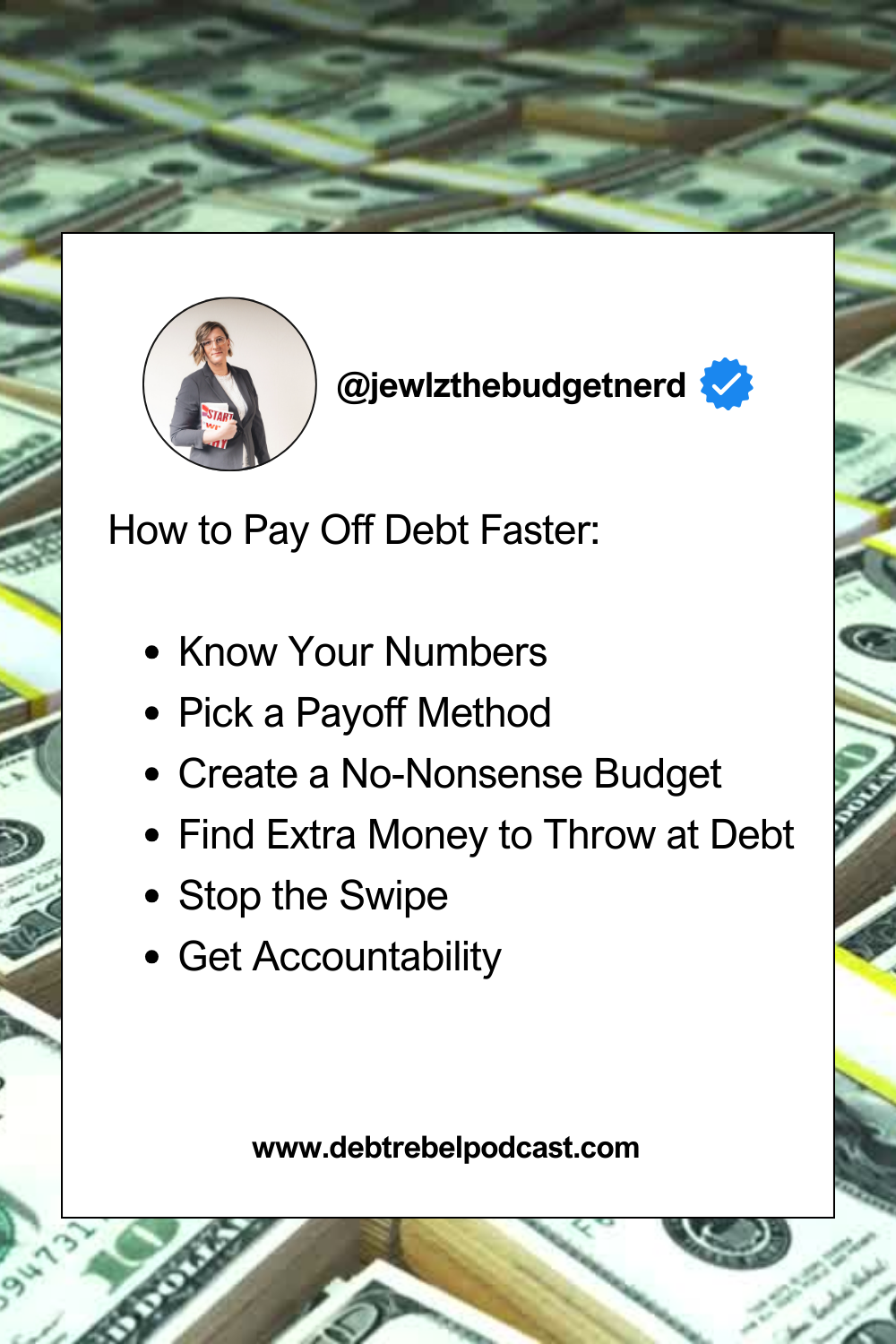
Step 3: Create a No-Nonsense Budget
Your budget is your game plan for crushing debt faster. I recommend zero-based budgeting (EveryDollar is my favorite app for this). That means every dollar that comes in gets an assignment.
For this season, cut or pause anything that’s not essential. Cancel unused subscriptions, reduce eating out, and stop the random Target runs. BUT—make sure you still budget a little “fun money.”
Why? Because if your budget feels like suffocation, you’ll sabotage it. Give yourself breathing room while still staying focused.
Step 4: Find Extra Cash to Throw at Debt
This is where momentum really builds. Look for every dollar you can redirect toward your debt:
Sell stuff → If you’d donate it, someone will buy it. Facebook Marketplace is your friend. Even $10 here and there adds up.
Renegotiate bills → Call your internet or phone provider and ask for a lower rate.
Side hustles → Babysitting, Instacart, or freelance work can bring in extra cash.
-
Pause extras → Commit as a family to skip eating out for a month. Funnel that savings straight to debt.

Step 5: Stop the Swipe
If you keep swiping, you’ll never dig out. This might mean:
Removing cards from Apple Pay.
Freezing your card in a block of ice (yes, I literally did this).
Using cash or debit only.
It should hurt a little to spend money—that tiny pause gives your brain time to say, “Wait, do we really need this?”
And remember: pause all new debt. No new credit cards, no “buy now pay later,” and no store cards. That “extra 10% off” isn’t worth years of payments.
You might also enjoy:
How to Stop Putting Groceries on a Credit Card (Even If the Math Feels Tight)
How to Stay Motivated During Debt Payoff (Even When You Want to Quit)
Step 6: Get Accountability
This is the piece my husband and I missed in our debt-free journey, and honestly—I wish we hadn’t. Doing this alone is heavy. Having someone in your corner cheering you on (while the rest of the world thinks you’re weird for cutting up your cards) makes all the difference.
Tired of watching your credit card balance barely budge every month?
You didn't fail—you just haven't had the right support system. For just $49/month, The Alliance gives you direct coaching, debt payoff tools, and monthly accountability check-ins to make sure every dollar you throw at debt actually makes an impact.
The Mindset Shift: From Shame to Strategy
Debt isn’t just a math problem—it’s a behavior and mindset shift. If you’ve been telling yourself “I’m just bad with money,” stop. That’s not the truth. The truth is, you’re learning a new way to interact with money.
Yes, people might think you’re weird for ditching credit cards. But being weird is what will set you free.
Final Word: Progress Beats Perfection
Paying off debt isn’t about doing everything perfectly—it’s about making steady progress. Small wins stack up. One less subscription, one item sold, one extra payment—it all moves the needle.
So if you’re tired of paying the minimum and watching your balance barely budge, it’s time to get rebellious, create a plan, and get your freedom back.
Ready to Eliminate Credit Card Debt for Good?
You don't have to navigate interest rates, budgeting tweaks, and debt payoff solo. Let's make your money transformation official.
What's waiting for you inside The Alliance:
Live monthly coaching & Q&A sessions with Jewlz.
Actionable roadmaps to pay off debt without living on ramen.
The "Stuck? We Troubleshoot" support system so you never stall out.
Grab your ADHD-friendly Paycheck Planner FREE!
The first steps I took to pay off over $107k in debt!
About Jewlz The Budget Nerd
Your ADHD Money Coach & Advocate
Certified Financial Coach & Award-Winning Host of the Debt Rebel Podcast: Personal Finance for Families
Julian "Jewlz The Budget Nerd" Kohlbrand is on a mission to empower families to take control of their finances and reclaim their time. Through her coaching practice and podcast, she provides practical advice, actionable strategies, and ADHD-friendly support to help individuals and families achieve their financial dreams.
After studying personal finance for over 25 years and eliminating over $107,000 of consumer debt with her husband, she learned managing money is about more than numbers and spreadsheets. Developing a personal money management system has ripple effects in other areas of life including your marriage, parenting, and work-life balance.
She also shares her wisdom and insight weekly as the award-winning host of The Debt Rebel Podcast: Personal Finance for Families. Available wherever you listen to podcasts or at debtrebelpodcast.com.
Join the Email List
Expand your personal financial knowledge today!